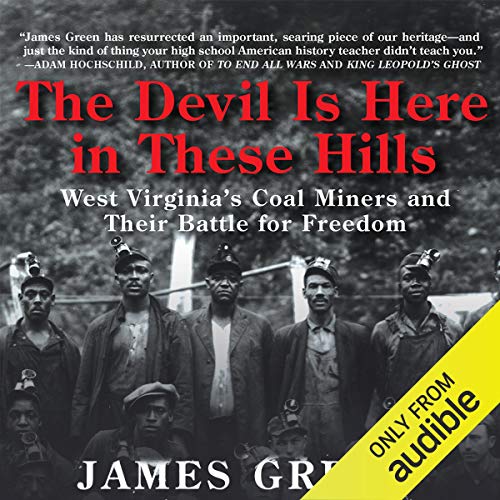
Title: The Devil Is Here In These Hills: West Virginia’s Coal Miners and Their Battle for Freedom
Author: James Green
Narrator: Joel Richards
Length: 11 hr 52 min

“God does not walk in these hills…The devil is here in these hills, and the devil is greed.”
General Charles D. Elliott
As a West Virginian, I will admit I only recently learned about the mine wars. About four years ago my work created an exhibit and presentation about it be mine wars and it was my first exposure to our states labor history. The reason for my ignorance about this topic is that it’s not tough in our West Virginia history classes or in our normal history classes. This is a topic that has been neglected, and continues to be neglected, most likely because companies, especially coal companies, don’t want their workers striking for a better workplace.
This was a very comprehensive and informative book about the decades long fight of West Virginia coal miners. This book started with the early strikes at Cabin Creek in 1912 and continued until 1921 with the Battle of Blair Mountain, and then he covers what happened afterwards. This discusses the working conditions, the housing, the strikes, and the struggle to form a union to change the coal companies. These coal miners were basically enslaved to their coal companies because the coal companies controlled everything in their lives. They had to use company script for pay and all their goods, and it wasn’t transferable to another company. Also it was cash, so couldn’t be used outside a mining town. It sounds like a horrible cycle that workers couldn’t get away from.
Green does a great job at leading the reader from strike to strike and the culmination of their fight on Blair Mountain. It was a very interesting and captivating recount of history that kept me hooked to these people’s individual stories and the overall fight. I am amazed that these miners had to fight for so long and so hard just to get some resolution. They didn’t even get everything they wanted in the end!
The Battle of Blair Mountain was not only the largest labor uprising since the Civil War, it was also the only time that American citizens were subjected to aerial bombardment on their own soil. This battle was intense for how short it was. The battle lasted five days and roughly 10,000 armed coal miners confronted 3,000 lawmen and strikebreakers. About 1 million rounds were fired and the National Guard had to intervene to stop it. This battle was crazy, not only because it was the first time this happened, but also because only a small number of people were killed.
“There is never peace in West Virginia…because there is never justice.”
Mother Jones
The conclusion of Blair Mountain is very surprising for me. Because while the miners might have held off the coal companies on the mountain, they stopped fighting when the National Guard arrived. Also, what is really crazy is that while they fought so hard for change, the coal industry actually won in the end. The UMWA membership plummeted and the idea of a union in West Virginia disappeared, so the coal industry continued their predatory practices.
Now, Blair Mountain is listed on the National Register of Historic Places (NRHP), but that also came about after a long battle. The coal companies, mainly Don Blankenship from Massey Energy, fought back and ended up getting the mountain removed from the register shortly after it was added. After a many years’ battle, Friends of Blair Mountain and some of the descendants of the miners, was finally able to get it relisted in 2016. I am heartened to learn that this important piece of West Virginia’s history is being preserved and used to teach the history of our state. I am definitely going to try and visit it.
My only real complaint with this book was that it got a bit dense at times on the information dumping to where I struggled to remember how the main story branched off to this topic. This probably wouldn’t be such an issue if you had the physical book, but with an audiobook it doesn’t work. I still feel like I learned a lot from this though.
Overall, this was a fascinating piece of West Virginia history. I learned so much about the history of the state from this book, like the origin of the word Rednecks.
TW: murder and death; coal mining disasters; racism; racist slurs; physical abuse; homelessness; starvation; child death; flooding disaster; imprisonment; war themes; gun violence;
Goodreads | The StoryGraph | Amazon
 Red-Haired Ash Reads